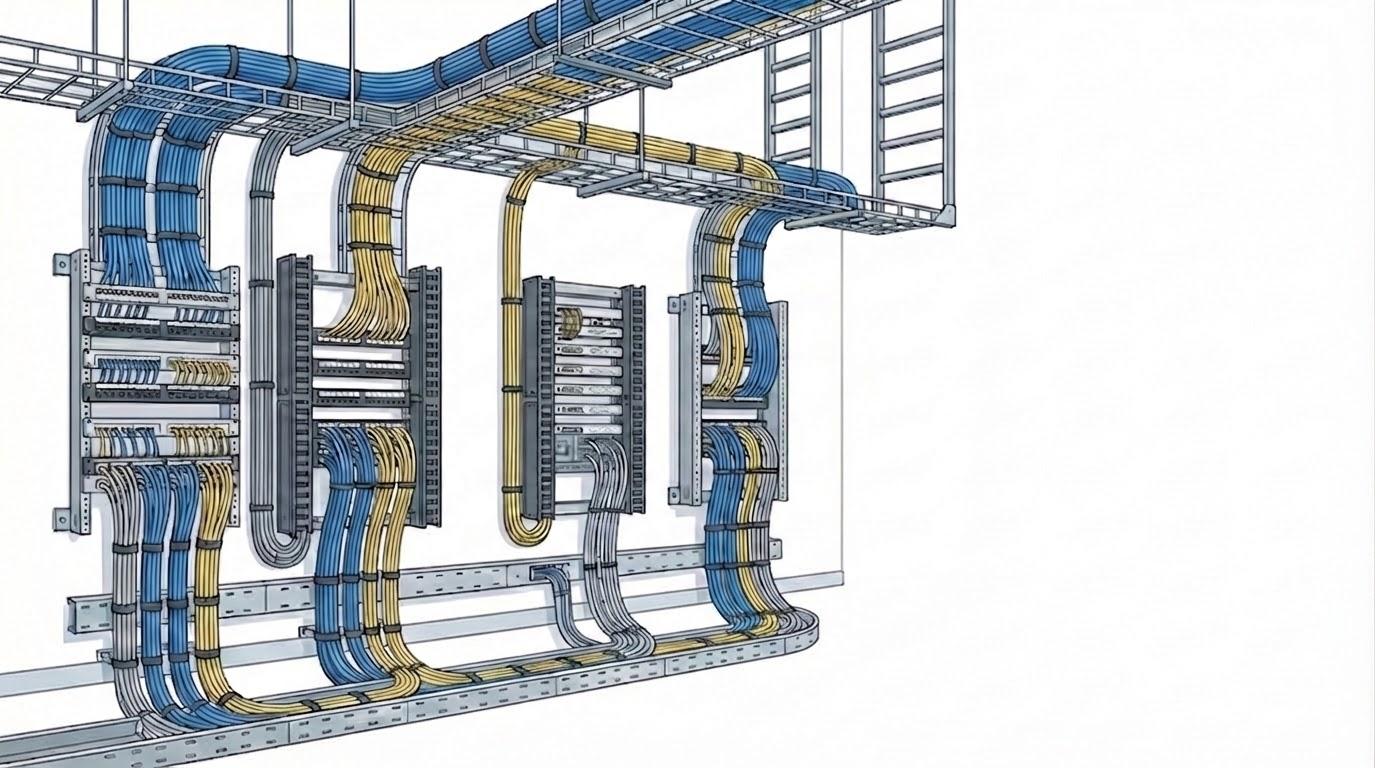
This phase establishes the "riser" system that connects the building's main entrance or equipment room to telecommunications rooms (TRs) on different floors.
Pathway Installation: Mounting conduits, cable trays, or vertical sleeves between floors.
Cable Pulling: Routing high-capacity cables (copper or fiber) through vertical risers.
Termination: Connecting backbone cables to the Main Distribution Frame (MDF) and Intermediate Distribution Frames (IDF).
Horizontal Cabling Installation
This phase covers the cabling from the TR on a specific floor to the individual work area outlets.
Route Deployment: Installing cables through ceilings, walls, or underfloor raceways.
Length Compliance: Ensuring runs do not exceed the 90-meter (295 ft) limit to meet TIA/EIA standards.
Work Area Outlets: Installing and terminating faceplates, jacks (e.g., Cat6/6a), and surface-mount boxes at user desks or device locations.
Fiber Optic Backbone Installation
Specifically focuses on high-speed, long-distance links often used for the vertical backbone or connecting separate buildings in a campus environment.
Fiber Selection: Installing single-mode or multi-mode fiber based on distance and bandwidth needs.
Fusion Splicing/Termination: Precise termination of fiber strands into fiber patch panels or enclosures.
Pathway Protection: Using innerduct or dedicated conduits to protect fragile fiber strands.
Local Area (LAN) and Wide Area (WAN) Network Installation
While the SCS is the physical layer, this phase includes setting up the active equipment that uses the cabling.
Hardware Mounting: Installing network switches, routers, and firewalls into standard 19-inch racks.
Patching: Connecting the installed horizontal and backbone cabling to the active network equipment using patch cords.
Wireless Access Points (WAPs): Mounting and connecting WAPs to extend the LAN via Wi-Fi.
Testing, Labeling, and Documentation
Crucial for system handover and long-term maintenance.
Certification Testing: Using industry-standard testers (like Fluke) to verify that every link meets performance standards (e.g., Cat6a or Fiber 10G).
System Labeling: Applying standardized labels to all cables, faceplates, and patch panel ports for easy troubleshooting.
As-Built Drawings: Providing the client with finalized floor plans and logical diagrams of the completed installation.